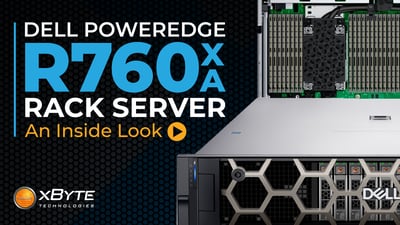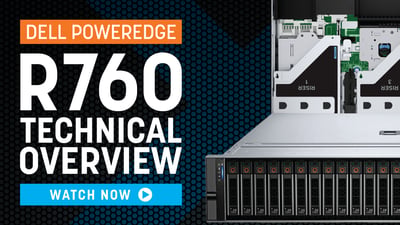
As AI, analytics, and GPU-backed workloads continue to grow, customers are increasingly comparing the PowerEdge R760 and R760xa. Both platforms are built on Dell’s 16th-generation PowerEdge architecture and share the same core foundation — but they are optimized for different design priorities.
The R760 is a highly adaptable, general-purpose platform.
The R760xa is engineered specifically for dense GPU acceleration.
Let’s break down the core differences and why they matter.
Core Platform Comparison
| Category | PowerEdge R760 | PowerEdge R760xa | Operational Impact |
|---|---|---|---|
| CPU | Dual Intel Xeon Scalable (4th/5th Gen) | Dual Intel Xeon Scalable (4th/5th Gen) | Same compute foundation |
| Max Cores | Up to 128 total cores | Up to 128 total cores | Equal CPU capability |
| Max Memory | Up to 8TB DDR5 | Up to 8TB DDR5 | Equal memory ceiling |
| GPU Support | Up to 2 x 350W DW or 6 x 75W SW | Up to 4 x 400W DW or 12 x 75W SW | Significant GPU density increase |
| PCIe Layout | Flexible, mixed expansion | GPU-optimized PCIe layout | Designed to sustain accelerator workloads |
| Thermal Design | General-purpose airflow | High-power GPU-optimized airflow | Sustained GPU performance |
GPU Density & Acceleration Capability
This is the primary differentiator between the two systems.
While both servers support GPU configurations, their density differs materially:
- R760: Up to 2 double-wide 350W GPUs or 6 single-wide GPUs
- R760xa: Up to 4 double-wide 400W GPUs or 12 single-wide GPUs
That increase in GPU density changes how customers approach:
- AI inference and training
- GPU-backed VDI
- Data analytics workloads
- Rendering and simulation
Importantly, the R760 is absolutely capable of GPU workloads. In fact, at the time of writing, only a small subset of GPUs supported in the R760xa are not supported in the R760.
The key distinction is not compatibility — it’s scale and sustained performance under load.
When acceleration becomes central to the workload, GPU density and thermal design begin to matter significantly.
PCIe & System Layout
Both platforms support PCIe Gen5 expansion, but their chassis layout reflects different priorities.
The R760 is designed as a flexible expansion platform. Its riser options support a mix of networking, storage adapters, and limited GPU configurations, making it well-suited for environments where expansion diversity matters.
The R760xa, by contrast, is architected specifically around accelerator density. It features riser configurations optimized for double-wide GPU spacing, dedicated x16 Gen5 lane allocation for accelerators, and a higher overall PCIe slot density dedicated to GPUs. Power delivery and PSU options are also scaled to support sustained 400W GPU loads.
In addition, the thermal design and airflow channels are engineered to maintain consistent cooling across multiple high-power GPUs operating simultaneously. This ensures sustained PCIe throughput and prevents performance throttling under heavy acceleration workloads.
Operationally, this means the R760xa is not simply “GPU compatible” — it is physically and electrically optimized for high-density accelerator environments.
Storage Considerations
Storage options remain enterprise-grade on both systems.
The R760 offers broader storage configuration flexibility, making it ideal for mixed-use environments.
The R760xa maintains strong NVMe support but allocates chassis design and airflow around GPU density first. This is not a limitation — it is a design prioritization.
In GPU-heavy environments, feeding accelerators efficiently is more important than maximizing storage permutation flexibility.
Why This Matters for SMB Environments
For most SMB customers, the first question is not “Which one is more powerful?” — it’s “Will I actually use the acceleration capacity?”
Typical SMB deployment patterns include:
- Virtualization clusters (10–80 VMs per node)
- ERP / SQL workloads
- Light analytics
- Smaller VDI environments
- 5–7 year refresh cycles
When the R760 Makes More Sense for SMB
- Mixed workload environments
- Occasional GPU usage
- Flexibility for repurposing hardware later
- Budget alignment without over-investing in acceleration
When the R760xa Makes Sense for SMB
- GPU-backed VDI is central
- AI workloads are core to business operations
- Rendering or analytics are revenue-driving
- Acceleration density reduces node count
For SMBs without sustained GPU workloads, the R760 often provides the right balance of performance and cost alignment. For SMBs actively investing in AI or GPU-backed services, the R760xa provides future-ready capacity.
Why This Matters for Enterprise Environments
Enterprise environments operate differently.
Infrastructure decisions are often driven by:
- Rack-level density
- Accelerator consolidation ratios
- Power and cooling efficiency
- AI roadmap planning
- Standardization across multiple data centers
When Enterprises Choose R760
- General-purpose compute clusters
- Mixed virtualization environments
- Gradual AI adoption
- Flexible workload reassignment over lifecycle
When Enterprises Choose R760xa
- AI and ML pipelines
- High-density GPU-backed VDI
- Rendering farms
- Analytics clusters
- Accelerator-heavy consolidation strategies
In enterprise environments, GPU density can materially impact rack design, power draw modeling, and licensing models. The R760xa’s increased accelerator capacity may reduce the number of required nodes for AI-focused deployments.
Conclusion
Both the PowerEdge R760 and R760xa share the same strong 16G foundation — identical CPU and memory ceilings — but they are optimized for different infrastructure goals.
The R760 remains one of Dell’s most versatile and adaptable platforms, capable of handling a wide range of workloads, including moderate GPU acceleration.
The R760xa is purpose-built for high-density acceleration, delivering greater GPU scalability and sustained performance when AI, analytics, and GPU workloads become central to the environment.
The right choice is not about which server is better.
It’s about whether acceleration is supplemental — or foundational — to your infrastructure strategy.