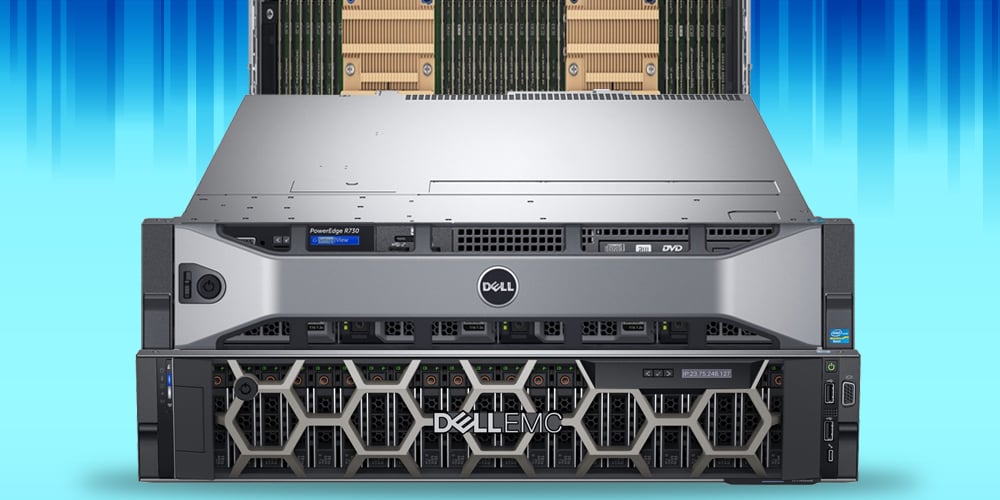

Summary of Server Differences
The Dell PowerEdge R730 and R740 servers are very similar in the number of components you can put in them. The one exception is with GPUs; you can fit 50% more GPUs (a total of three double‑wide or six single‑wide GPUs). There are still no NVMe capabilities, but the one drive enhancement is directed at those running Hyper‑V. You no longer have to use one or two of your drive bays for the OS. The R740 (and all 14th generation Dell servers) offers optional M.2 boot drives called BOSS (Boot Optimized Storage Solution). Hyper‑V did too many writes back to disk, which made running it from SD cards impractical and not recommended. Beyond the drives themselves, the new H740P RAID card in the R740 gives some extra power with 8GB cache and support for PCI‑Express 3.1.
The CPUs are the big upgrade with the R740 over the R730. Intel's new line of scalable processors is pretty impressive. Leading CPU benchmarking source PassMark has the middle‑of‑the‑road CPU for the R730, E5-2660v4, with a similar single‑thread rating as the lower‑end R740 CPU, Silver 4214. When you move up on the R740, you really start to outshine the R730. The Gold 6230 has about a 20% increase in single‑thread rating compared to the E5-2660v4. The max core count for an R730 CPU was 22 cores, but 22 cores is pretty common with Gold CPUs and the top‑of‑the‑line Platinum 9282 CPU maxes out at a ridiculous 56 cores.
The additional processing power does come at an initial price, but you make up a little each year with better power efficiency. If you need the power and extra GPU options of the R740, you will not be disappointed. If you don't need that power, save the money and maybe look at upgrading your network to 25GbE. Both servers offer 25GbE PCIe cards, which can be an inexpensive way to improve performance.