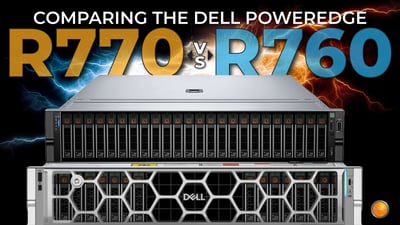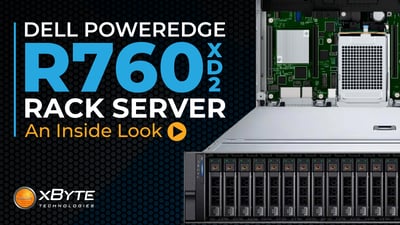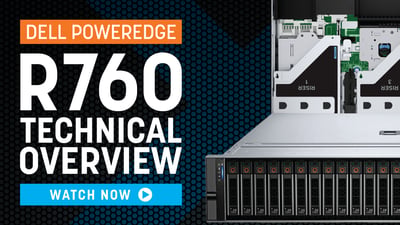
The Dell PowerEdge R760 has become one of Dell’s most popular 16th Gen platforms, and honestly, it’s earned that reputation. It’s flexible, powerful, and fits perfectly in just about any enterprise environment.
Alongside it, Dell offers the Dell PowerEdge R760xs. Same generation, same 2U form factor, same Xeon Scalable foundation, but built for a different type of customer.
This isn’t a “good vs better” comparison. It’s about understanding how each server is meant to be used so customers can feel confident they’re buying the right platform for their workloads, growth plans, and budget.
Two Servers, Two Design Mindsets
The easiest way to think about this is intent.
The R760 is designed to be a do-it-all platform with “scalability” and “future-proofing” in mind. It’s the server you choose when workloads may change, expand, or stack over time, and you don’t want the hardware to be the limiting factor.
The R760xs is designed to be purpose-built and efficient. It assumes you already know what the server will be doing, and it focuses on delivering excellent performance for those workloads without unnecessary complexity.
Both approaches are valid, and both exist because customers operate differently.
Compute & Memory: Modern Performance Either Way
At a high level, compute performance is strong across both platforms. Both systems support dual Intel Xeon Scalable processors and DDR5 memory, so you’re not choosing between fast and slow.
The difference lies in scale and flexibility.
The R760 gives you more room to grow and more configuration freedom as it supports:
- Up to 2 CPUs of higher core counts (up to 64 cores via 5th Gen Intel Xeon Scalable processors, or up to 56 cores via 4th Gen Intel Xeon Scalable processors)
- More DIMM slots (up to 32 DIMM slots for a maximum of 8TB memory)
This makes the R760 ideal for mixed workloads, databases, or environments where requirements evolve over the server’s lifecycle.
On the other hand, the R760xs keeps things more streamlined for customers who need more scalability than a 1U server provides, but don’t necessarily need everything that the R760 has to offer.
The R760xs supports:
- Up to 2 CPUs of up to 32 cores (5th Gen Intel Xeon Scalable) or up to 28 cores (4th Gen Intel Xeon Scalable)
- Up to 16 DIMM slots (maximum of 1.5TB RAM)
Even with offering a lower performance ceiling, the R760xs is still capable of handling most enterprise workloads, including virtualization, HCI, application hosting, and more. For customers deploying clusters of identical nodes, that consistency makes design and lifecycle management easier while still delivering ample performance.
Storage: Flexibility vs Consistency
Storage is another area where the difference is not about better or worse, but about design philosophy.
The R760 is a great fit when storage architecture matters. If you’re mixing NVMe, SAS, and SATA, designing IOPS tiers, or supporting multiple workload types in a single server, the R760 gives you the flexibility to do that.
The R760xs focuses on predictable, repeatable storage layouts. That’s especially attractive for scale-out designs like HCI or virtualization clusters, where consistency across nodes is more important than having dozens of configuration permutations.
In simple terms:
Expansion & PCIe: Planning for Change vs Planning for Scale
This is usually where customers start to feel the difference.
The R760 offers broader PCIe expansion, making it a strong fit for environments that may introduce GPUs, accelerators, or additional networking over time. It supports up to eight PCIe slots and can accommodate up to six single-width GPUs or two double-width GPUs.
The R760xs still supports modern networking, including high-speed NICs, but keeps expansion focused on what most deployments use. It supports up to six PCIe slots and up to two single-width GPUs. For customers rolling out large numbers of servers, this predictability simplifies everything from procurement to support.
Neither platform limits performance. They simply support different operational strategies.
Where Each Server Shines
In real-world environments, both the R760 and R760xs appear across a wide range of workloads. Technically, both platforms can be used for almost anything listed below.
The difference usually comes down to how customers think about growth, standardization, and cost, not what the server is capable of.
Customers often lean toward the R760 when:
- They want a single platform that can adapt as workloads change.
- They’re consolidating mixed workloads onto fewer hosts.
- GPU acceleration may be needed now or later.
- Long-term flexibility is part of the design goal.
Customers often lean toward the R760xs when:
- Workloads are clearly defined from day one.
- They’re building repeatable, scale-out clusters.
- Simplicity and consistency matter more than optional expansion.
- Budget efficiency is a priority without sacrificing 16G performance.
In many environments, both models coexist. R760 systems handle more flexible or specialized roles, while R760xs nodes form the backbone of standardized clusters.
Budget Isn’t a Compromise, It’s Part of the Design
One of the key advantages of the R760xs is that it aligns cost with intent. Customers are not paying for flexibility they don’t need, which often results in a lower cost per node and easier standardization across a cluster.
The R760 earns its price when flexibility translates into operational value, whether through future expansion, workload consolidation, or adapting to changing business needs.
Both platforms are smart investments when matched to the right use case.
Final Thoughts
The PowerEdge R760 and R760xs aren’t competing servers, but complementary ones.
If you want maximum flexibility and a platform that can evolve alongside your environment, the R760 is a proven, rock-solid choice.
If you want a streamlined, efficient server that excels in scale-out and well-defined workloads, the R760xs delivers exactly that.
When customers understand why each model exists, the decision becomes much easier and can be made with more confidence.