

With the 17G PowerEdge generation, Dell added two new-to-the-portfolio models that didn’t exist as direct equivalents in prior generations: PowerEdge R770AP and PowerEdge R7725xd.
These systems are not replacements for the “standard” R770 and R7725. Instead, they’re purpose-built variants designed to address specific performance bottlenecks increasingly common in modern data centers:
- Accelerated compute density on the Intel platform.
- All-out NVMe storage performance and density on the AMD platform.
PowerEdge R770AP vs. PowerEdge R770
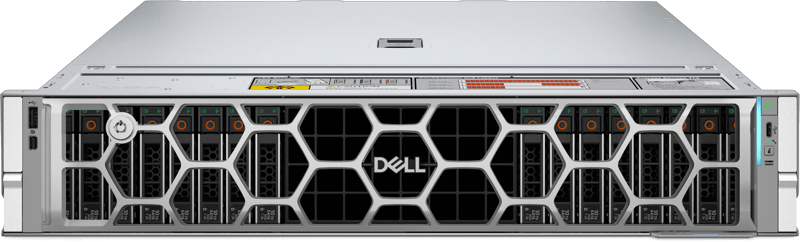 Dell PowerEdge R770AP
Think of the R770 as the broadly applicable, balanced 2U dual-socket Intel workhorse, built to standardize deployments across common enterprise workloads while still scaling up into performance-focused use cases.
The R770AP (Advanced Performance) is a 2U, dual-socket rack server engineered for high-performance computing, delivering exceptional power efficiency and balanced capabilities to enhance data center productivity. This system demonstrates superior performance in handling large-scale workloads such as virtualization, data-intensive analytics, and mission-critical databases, primarily due to its higher P-Core processor count compared to the R770.
Key Differences
CPU Support
- R770: Supports two Intel Xeon 6 processors up to 144 E-Cores or 86 P-Cores each
- R770AP: Supports two Intel Xeon 6 6900-series P-core processors up to 128 cores per processor
Memory
- R770: Supports up to 8TB of DDR5 6400 MT/s memory
- R770AP: Supports up to 3TB of DDR5 6400 MT/s memory
Cooling
- R770: Supports air-cooling or optional Direct Liquid Cooling
- R770AP: Supports air-cooling only
Workload Intent
- R770 (standard):
- General enterprise compute
- AI Inferencing
- Software Defined Storage (SDS)
- R770AP:
- Consolidating demanding enterprise workloads at scale
- Large-scale virtualization, mission-critical databases, analytics
PowerEdge R7725xd vs. PowerEdge R7725
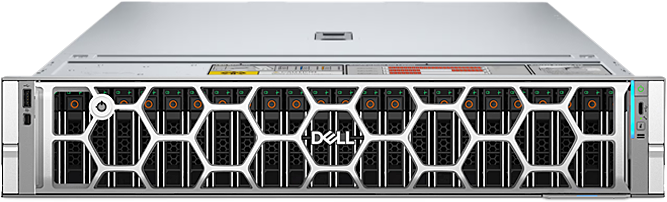 Dell PowerEdge R7725xd
The R7725 offers a versatile, high-powered AMD 2U dual-socket platform, making it an excellent choice when you need robust CPU performance, ample memory, and flexible I/O and storage configurations that can be tailored for a wide range of use cases.
The R7725xd (extra disks) takes a different approach. While it shares the same 2U dual-socket class, it is built for storage-dense, high-performance NVMe Gen5 deployments, including support for 24 x 2.5-inch U.2 Gen5 NVMe drives. That storage-first design can materially change which workloads it’s best for, favoring I/O-heavy and NVMe-centric use cases.
Key Differences
Memory
- R7725: Supports up to 6TB of DDR5 6400 MT/s memory
- R7725xd: Supports up to 3TB of DDR5 6400 MT/s memory
Chassis Options
- R7725: Wider variety of chassis options including 3.5” SAS/SATA, 2.5” SAS/SATA/NVMe, and EDSFF E3.S
- R7725xd: Limited to 24 x 2.5” U.2 Gen5 NVMe
Cooling
- R7725: Supports air-cooling or optional Direct Liquid Cooling
- R7725xd: Supports air-cooling only
Workload Intent
- R7725:
- Traditional and emerging workloads
- Big data analytics
- AI/ML and HPC (High Performance Computing)
- R7725xd:
- Any workload requiring tremendous storage-density – up to 2928 TB raw
- Ideal for Object Storage
A central architectural focus of the R7725xd is minimizing the “hidden tax” often found in high-speed NVMe solutions, where bandwidth is split or shared among drives. The PowerEdge R7725xd addresses this by dedicating x4 Gen5 PCIe lanes to each drive, guaranteeing that every drive’s bandwidth remains fully available and uncontested.
Final Takeaway: Why These New Models Matter
The introduction of R770AP and R7725xd is a signal that “one-size-fits-most” isn’t enough at the high end of modern data centers.
- R770AP was developed in response to the rising prevalence of enterprise needs and consolidation strategies. Many organizations now prefer a platform specifically designed and optimized for these requirements, rather than adapting a generic solution.
- The R7725xd was designed to tackle widespread storage performance bottlenecks by prioritizing storage bandwidth and concurrency, rather than simply increasing the number of drive bays.
For most IT environments running a general virtualization, a mix of enterprise applications, and planning for steady, predictable growth, the PowerEdge R770 and R7725 remain reliable, foundational choices. These models deliver balanced performance and scalability well-suited to a wide range of standard workloads.
When organizations face more specialized challenges, such as the need for significantly higher compute density or demanding NVMe storage performance and capacity, the R770AP and R7725xd models are purpose-built to address those challenges. These advanced systems are engineered to overcome the limitations of traditional platforms, providing targeted solutions for high-intensity data center tasks where standard options may fall short.